The text is clean Unicode, stable, and free of stray circles. Now comes the work no software can do for you: deciding whether every letter, mark, and pitch accent is actually correct. For an ordinary document a spellchecker is enough. For a sacred one it is nowhere near — and here is how we read it with the attention such a text demands.
New here? This is one article in a Gurugo Labs field series drawn from a client engagement to produce a traditional trilingual (Sanskrit · Tamil · English) devotional book — but it reads on its own. This article: why proofreading a traditional or sacred text is a different, harder task than ordinary spell-checking, and how we approached it. One term you'll need: a svara is a Vedic pitch accent — a small mark that tells the reciter how a syllable is to be intoned.
Why a spellchecker is the wrong tool
A spellchecker asks one question: is this a word I recognize? That is a useful question for a letter or an essay. It is almost useless for a sacred text, because the thing that must be verified is not "is this a word" but "is this the correct word, in the correct form, with the correct marks, in the correct order — as the tradition has preserved it."
No dictionary can answer that. The authority for a liturgical text is not a spellchecker; it is the received tradition and the people who carry it. Proofreading here means checking the text against that authority, letter by letter, with a specific and unusually patient kind of attention.
The layer a casual eye slides straight past
Most of a passage is easy to check: the consonants and vowels are large and familiar, and errors in them tend to leap out. The danger lives in the small marks — and above all in the pitch accents, the svaras.
In a Vedic text, syllables carry accent marks that tell the reciter how to intone them: a stroke below the letter, a stroke above it, or no mark at all. These are not decoration. They are part of the text's meaning and its correct recitation, and they are the single most fragile thing in the whole document — tiny, easily dropped in conversion, easily misplaced by a stray edit, and easy for the eye to skate over because they are so small.
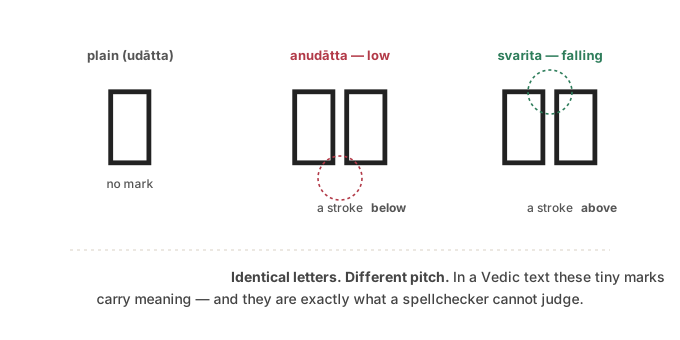
Look at the three forms above. The letter is identical in all three. What differs is a hairline stroke above or below — and that difference is exactly the part an automated check is blind to and a hurrying eye forgets to inspect. Proofread a Vedic text the way you'd proofread an email, and the accents are precisely what you will miss.
How we actually read it
The method is less about cleverness than about slowing down and separating the passes. Reading for everything at once is how errors survive. Instead, read the same text several times, each time looking for only one kind of thing:
Pass 1 — the consonants and vowels. Just the letters, ignoring every mark. Are the words right, in the right form, in the right order?
Pass 2 — the vowel signs and small marks. Now the anusvāra dots, the visarga, the vowel signs. Nothing stray, nothing missing.
Pass 3 — the accents alone. Read only the svaras. Is every mark present where the tradition places it, above or below the right syllable? This pass feels strange — you are half-ignoring the words — but it is the one that catches what nothing else will.
Pass 4 — against the source. Finally, compare the text line by line against an authoritative printed edition, not from memory. (Checking against a scanned reference is its own task — the subject of a later article.)
Separating the passes works because attention is a narrow beam. Ask it to watch for letters, marks, accents, and fidelity all at once and it watches for none of them well. Give it one job at a time and it becomes remarkably sharp.
The rule that protects you from yourself
There is a specific hazard when a careful person proofreads a traditional text: the temptation to "correct" something that looks unusual but is in fact the authentic reading. Sacred texts contain archaic forms, deliberate irregularities, and sandhi (the way sounds join across words) that can look like mistakes to a modern eye.
So the governing rule is: verify against the tradition; never normalize from intuition. If a reading looks wrong, treat that as a question for an authority, not a licence to change it. A confident "fix" is how a faithful text quietly acquires an error that then propagates into every copy made from it.
How we solved it on the engagement
This is the point where software stops and scholarship begins — so we brought a Sanskrit scholar onto the engagement. The division of labour was deliberate: our tooling guaranteed the text was technically sound (correct Unicode, consistent normalization, no orphaned marks), and automated checks flagged — never fixed — suspicious patterns for review: an accent on an unexpected base, a syllable carrying two conflicting accent marks, an expected mark that had gone missing. The scholar then adjudicated the things only a human authority can: which reading is correct, where an unusual form is authentic, and whether each svara sits exactly where the tradition places it. Engineering made the text trustworthy to the machine; the scholar made it trustworthy to the tradition. Neither alone would have been enough.
⚙️ For the hands-on reader
- Automated help has a ceiling here, but it isn't zero: a script can flag — never fix — suspicious patterns for a human to review.
- Normalizing to a single Unicode form first (see the article on files that break themselves) makes accent-checking far more reliable, because identical-looking sequences then really are identical.
- Keep an untouched copy of the source text. Every change should be a deliberate, reviewable difference against it, not an edit made in place and forgotten.
Why this article matters more than the others
Everything earlier in this series is about making the text display correctly. This one is about making it be correct — and for a sacred book that is the whole point. A beautifully typeset text with a dropped accent is not a beautiful book; it is a flawed one dressed well.
And there is a limit worth stating plainly: some of this genuinely requires a teacher. A printed book can preserve the marks, but the correct recitation of the svaras is something a qualified ācārya transmits in person. The proofreading here makes the written record faithful; it does not replace the living transmission behind it.
Takeaways
- A spellchecker asks "is this a word"; a sacred text needs "is this the correct reading" — a different, human question.
- The pitch accents (svaras) are the most fragile, most overlooked part — tiny marks that carry meaning.
- Proofread in separate passes — letters, then small marks, then accents alone, then against the source.
- Verify against the tradition; never normalize from intuition — an unusual reading may be the authentic one.
- Software can flag suspects but not judge correctness — which is why the engagement paired tooling with a Sanskrit scholar.