The main content is laid out — but a book doesn't begin with its content. It begins with a title page, perhaps a foreword, a table of contents, a page that tells you how to read it. These are the front matter, and they are a large part of what makes a stack of laid-out pages feel like an actual book.
New here? This is one article in a Gurugo Labs field series drawn from a client engagement to produce a traditional trilingual (Sanskrit · Tamil · English) devotional book — but it reads on its own. This article: what the pages before the main content are, what each is for, and the special front-matter pages a scholarly or devotional book needs. One term you'll need: front matter is the set of pages that come before the main text — title page, foreword, table of contents, and so on.
Why a book needs a "before"
Open any published book and you don't land straight in Chapter 1. You pass through a small, quiet sequence of pages first: the title, who made it, a word of introduction, a map of what's inside. This is the front matter, and its job is to establish the book — to say what this is, who stands behind it, and how to use it — before the content begins.
Skipping it is one of the clearest tells of a home-made book. Including it, in the conventional order, is one of the cheapest ways to make a book feel considered and complete.
The usual sequence
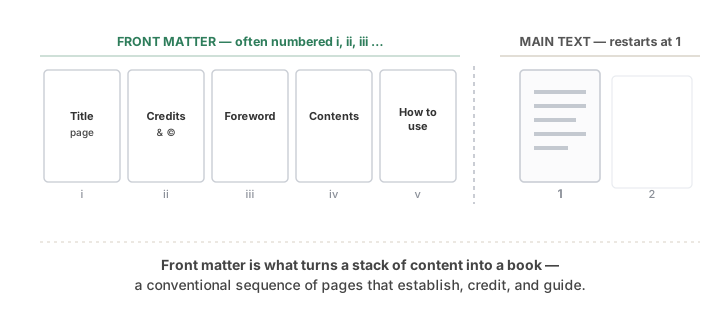
Front matter follows a familiar order. Not every book uses every element, but the order is conventional, and following it makes a book feel right even to a reader who couldn't name why.
Title page. The book's full title and whatever belongs with it — compiler or editor, tradition, year. The formal "this is the book" page, conventionally a right-hand page.
Credits / copyright page. Usually on the back of the title page: who holds the rights, who contributed, edition and printing details, acknowledgements. For a freely-given devotional work this page still matters — it's where provenance and thanks are recorded honestly.
Dedication (optional). A short offering or dedication, if there is one.
Foreword or preface. A foreword is typically written by someone other than the compiler — an elder, a teacher — lending blessing or context; a preface is the compiler's own note on why and how the book came to be.
Table of contents. The map of the book, with page numbers.
A "how to use this book" or conventions page. Optional for a novel, close to essential for a scholarly or multi-script text.
Then the main content begins.
A detail that quietly signals "book": the numbering
Front matter is often numbered in small roman numerals (i, ii, iii…), and the main text restarts at page 1. This isn't fussiness: it lets the front matter grow or shrink — a longer foreword, an added page — without renumbering the whole body. A small thing that makes a book feel professionally produced.
The table of contents should be built, not typed
One firm rule: never type your table of contents by hand. The moment the layout shifts — a corrected line, an added page — hand-typed page numbers become quietly wrong, and a wrong contents page is worse than none. Generate the contents from the book's own headings so entries and page numbers come from where things actually are, and regenerate whenever the layout changes.
The conventions page: where a specialized book earns trust
For a book in multiple scripts, or one carrying Vedic accents, add a page that explains its own conventions — the page that turns a potentially confusing object into a usable one. State briefly and clearly: which scripts appear and how they're arranged; the transliteration scheme; what the special marks mean (in particular that the accent marks are pitch guides, not errors); and any editorial choices, so nothing looks like a mistake.
And for a sacred text, one more note belongs here, and it may be the most important sentence in the whole front matter: that the book is an aid to practice, not a substitute for a teacher. A printed page preserves the words and marks; the correct recitation is transmitted by a qualified teacher in person.
How we solved it on the engagement
We built the client's front matter as a deliberate set rather than an afterthought: a title page, a credits page that accurately and graciously acknowledged the family elder who contributed the foreword, the foreword itself, a table of contents, and a conventions page. Two things are worth borrowing.
First, we generated the table of contents from the book's heading structure with the same scripting we used for the running headers, so its page numbers were correct by construction and could be regenerated after any layout change — no hand-typed numbers to drift out of date.
Second, we treated the conventions page as a first-class deliverable. It set out the three scripts and their arrangement on the spread, the transliteration approach, and — most carefully — what the pitch-accent marks mean, so a reader would not mistake a svara for a typo. We also stated plainly, with the scholar's guidance, that the book is meant to sit alongside a teacher: it preserves the text faithfully but does not replace an ācārya's transmission of the recitation. On a devotional work, getting the credits gracious and the conventions honest is not decoration — it is part of doing right by the tradition and the people in it.
⚙️ For the hands-on reader
- Number front matter in roman numerals and start the main text at 1, so front matter can change without renumbering the body.
- Generate the table of contents from headings and regenerate after any layout change; never hand-type page numbers.
- Write a conventions page covering scripts, transliteration scheme, the meaning of the accent marks, and editorial choices.
- For a sacred text, state explicitly that it complements a teacher, not replaces one.
- Verify every name and credit before the book goes to print.
Takeaways
- Front matter — the pages before the content — is a large part of what makes a stack of pages read as a book.
- Follow the conventional order: title, credits, (dedication), foreword/preface, contents, conventions.
- Number front matter in roman numerals; restart the main text at 1.
- Generate the table of contents so its page numbers stay correct.
- A conventions page explains scripts, transliteration, and accent marks — and, for a sacred text, says the book complements a teacher rather than replacing one.